
Blog
Weed Boat Services: When Mechanical Weed Removal Is the Right Choice for Large Lakes, Fisheries and Restricted Access Sites
When large lakes, fisheries and awkward-access sites become choked with aquatic growth, weed boat services can offer a practical route to mechanical clearance.
9 November 2026 · 7 min read
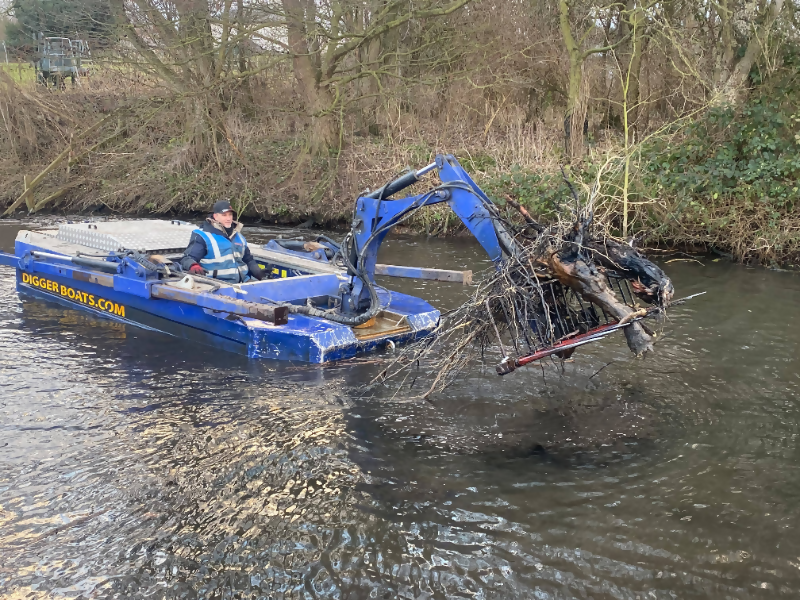
If a lake or fishery is covered in dense aquatic growth, choosing the right equipment matters as much as choosing the right contractor. Weed boat services are often the most practical answer where the waterbody is too large for simple hand clearance, too awkward for bank-based plant, or too sensitive to tackle with a one-size-fits-all approach.
At Digger Boats Ltd, we help landowners, fisheries, councils and businesses assess whether weed boat clearance is the right fit for the site, or whether the problem calls for wider lake restoration services. From our base in Braintree, CM7 5SL, we work across Essex, London and the wider UK using specialist aquatic equipment, digger boats and advanced amphibious machinery.
Not every overgrown lake needs a weed boat. But when open water is disappearing, fishable areas are shrinking and the banks are too soft or limited for conventional machinery, it can be one of the most efficient ways to carry out mechanical weed removal with less disruption than forcing the wrong setup onto the site.
What weed boat services are designed to do
Weed boat services are used to mechanically clear excessive aquatic vegetation from the water itself. That makes them especially useful where the priority is to reopen usable water, improve access across a broad surface area and remove growth that routine edge maintenance can no longer keep under control.
On the right site, a weed boat can help with:
Clearing dense weed from larger areas of open water
Improving access around fishing pegs, channels and usable lake frontage
Reducing surface and sub-surface growth that is affecting day-to-day use
Supporting wider maintenance plans for lakes, ponds and fisheries
Reaching areas that are awkward to tackle from the bank alone
The key point is that a weed boat is not simply a faster way to trim growth. It is a practical plant option for sites where the size of the waterbody, the nature of the vegetation or the access constraints make simpler methods inefficient.
When weed boat services are the best option
Large lakes and broad areas of open water
On a bigger lake, the challenge is often scale. A waterbody may have too much spread-out weed growth for manual clearance to be realistic, especially if the aim is to restore visible open water rather than just tidy one edge.
In that situation, weed boat services allow the work to happen out on the water where the problem actually sits. Instead of trying to reach everything from the margins, the clearance method matches the site.
This is often the point where owners start looking for a more structured solution because:
The lake looks progressively smaller as weed spreads further out
Open water routes are becoming harder to maintain
The amount of growth makes piecemeal clearance poor value
Regular use of the waterbody is starting to be affected
Fisheries where use of the water matters day to day
Fisheries usually need more than a cosmetic improvement. The water has to remain usable. If weed growth is making pegs harder to fish, narrowing channels, limiting presentation or reducing access to previously productive areas, a practical clearance plan becomes part of fishery management rather than a one-off tidy-up.
Weed boat services can be a strong fit here because they are geared towards restoring usable water space across the lake, not just cutting back a few visible sections from the bank. For fisheries, that can help with:
Reopening fishable water
Improving access around key pegs and margins
Making the site easier to manage through the season
Reducing the frustration that heavy growth causes for owners and users alike
Just as importantly, the right approach depends on what is growing and how far it has spread. A fishery dominated by open-water weed can need a different solution from one where reeds, rushes or lilies are the main issue.
Restricted access sites and soft or awkward banks
Some sites are difficult not because the weed is unusually severe, but because access from land is poor. Soft ground, narrow approaches, unstable edges or limited working room can all make bank-based methods less practical.
This is where weed boat services can come into their own. If the problem is on the water and conventional plant cannot sensibly reach it from the shore, working from the water may be the cleaner and more effective route.
Typical examples include:
Lakes with soft or unstable margins
Waterbodies with limited bank access for larger plant
Sites where working room is tight around the edge
Features where reaching the centre of the problem from land would be inefficient
That does not mean every awkward site automatically needs a weed boat. It means the machine choice should be based on access, condition and outcome, rather than on what would be easiest to send to site.
Why a weed boat can be more practical than simpler clearance methods
On the right project, the advantage of a weed boat is not just that it clears vegetation. It is that it does so in a way that suits water-led access and larger-scale coverage.
Benefits can include:
Better reach across the waterbody where weed is no longer confined to the margins
Less reliance on firm bank access where shore conditions are limiting the work
More efficient coverage on larger lakes and fisheries
A more targeted mechanical approach than improvised or repeated short-term cut-backs
Stronger fit with wider maintenance planning where ongoing lake management matters
In practice, that often means a better result with less wasted effort. It can also reduce the risk of choosing a cheap-looking option that fails because it never really matched the site in the first place.
When a weed boat may not be the full answer
One of the most important parts of a proper site assessment is recognising when weed is the main issue, and when it is only the visible symptom of something larger.
If the main issue is silt rather than vegetation
A lake can look choked with weed because it has become progressively shallower over time. In that case, vegetation clearance may improve matters in the short term, but it may not deal with the loss of depth that is encouraging recurring growth.
If that sounds familiar, the site may need dredging services or a broader restoration plan rather than weed removal alone.
If marginal growth is the bigger problem
Where the real restriction sits around the edges, a weed boat may not be the primary tool. Dense reeds, rushes, lilies or woody bankside vegetation often call for a different combination of clearance methods, especially if access points, inlets or margins are the main areas being lost.
If the site needs wider restoration
Some waterbodies have several connected problems at once. Weed may be only one part of the picture alongside poor water movement, silt build-up, drainage issues or long-term neglect. In those cases, weed boat services may still form part of the answer, but only as one element within a wider programme of work.
That is why we assess sites carefully before recommending a specific machine. The aim is not to push one service into every situation. It is to find the most practical route to the result you actually need.
What we assess before recommending weed boat clearance
Before we advise on weed boat services, we look at the conditions that will shape whether it is the right option.
The type of vegetation present. Different aquatic growth creates different clearance needs. Open-water weed, marginal growth and mixed overgrowth are not the same job.
The spread and density of the problem. A few localised patches may not justify the same approach as widespread coverage across a larger lake or fishery.
The depth and underlying bed condition. If heavy silt is part of the issue, a wider scope may be needed.
The access available to the site. Bank stability, launch options, working space and general logistics all matter.
The purpose of the waterbody. A commercial fishery, private estate lake, amenity pond or managed water feature may each require a different outcome.
The long-term maintenance plan. Good clearance decisions are not only about the next visit. They should also support easier management afterwards.
This assessment-led approach helps us recommend the right combination of digger boat services, weed boat clearance or wider restoration work, depending on what the site actually needs.
Why clients choose Digger Boats Ltd
Digger Boats Ltd was established in 2018 and provides specialist aquatic and environmental services across the UK. We work with businesses, landowners, councils and fisheries, combining practical site assessment with specialist machinery and environmentally responsible working practices.
Clients come to us when access is difficult, conditions on the ground are limiting conventional plant, or the problem needs more than a surface-level answer. Because we also carry out restoration, desilting, vegetation management and drainage-related works, we can take a broader view of the site instead of treating every job as a standard weed clearance exercise.
That matters when you want a realistic recommendation. If weed boat services are the right approach, we will say so. If another route is likely to deliver a better outcome, we will say that too.
Frequently asked questions about weed boat services
What are weed boat services used for on lakes and fisheries?
They are typically used to mechanically clear excessive aquatic vegetation where weed growth is affecting open water, usability, fishery access or general lake management. They are especially useful on larger waterbodies and sites where the work is difficult to carry out effectively from the bank.
Are weed boat services better than bank-based weed clearance?
Not always. The right option depends on where the growth is, how extensive it is and how easy the site is to reach. If the main problem sits out on the water or the banks are too soft or restricted for efficient land-based access, a weed boat can be the more practical choice.
Can weed boat services work on restricted access sites?
Yes, in many cases they are considered specifically because access from land is poor. Soft margins, limited working room and awkward approaches are all common reasons to assess whether a water-based clearance method makes more sense.
Will a weed boat remove silt as well?
Not necessarily. If the main restriction is built-up sediment, the site may need desilting or dredging rather than vegetation clearance alone. That is why it is important to assess whether the real issue is weed, silt or a combination of both.
How often does a lake or fishery need weed boat clearance?
There is no universal timetable. Frequency depends on the type of waterbody, the surrounding conditions, how quickly growth returns and what standard of usability you need to maintain. Sites that are heavily used or prone to recurring growth often benefit from a planned maintenance approach rather than waiting until the problem becomes severe again.
Conclusion
If you are dealing with heavy aquatic growth on a large lake, pond or fishery, or you are struggling with a site where access from the bank is poor, weed boat services may be the most practical route to effective mechanical clearance.
To discuss whether weed boat clearance is right for your waterbody, contact Digger Boats Ltd. We will assess the site around access, condition and the outcome you need, then advise on the most sensible next step.